

DeFi asset manager Zapper has announced plans to shut down after nearly seven years of operation.
To gauge the scale of its operation, the asset manager attracted over 2 million monthly active users while trading over $13 billion at its peak in trading volume.
However, the strong adoption from users did not translate into a sustainable business model as revenue dropped due to intense competition. This competition has squeezed the asset manager’s profit margins and disrupted its operations.
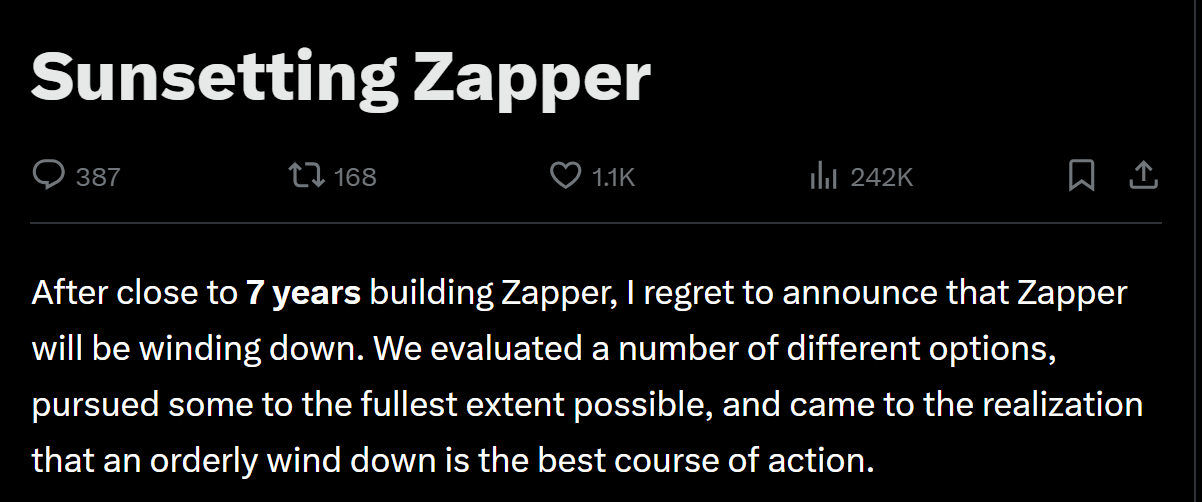
On August 3, the asset manager will completely close and cease operations. The platform will assist its users with the transition.
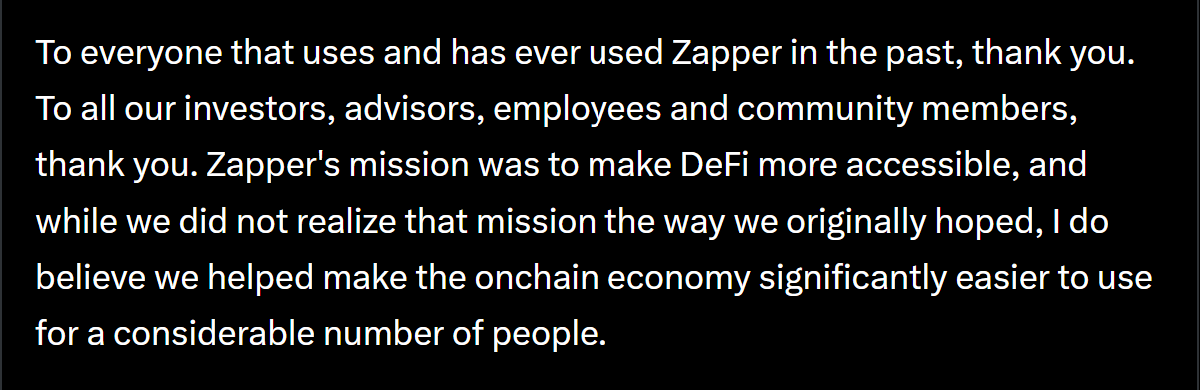
Zapper Co-Founder and CEO Seb Audet acknowledged that Zapper has failed to deliver on its mission. In a post on X he said:
Zapper’s mission was to make DeFi more accessible, and while we didn’t accomplish that mission in the way we originally hoped…
This shift has revealed the increasing difficulty of monetizing DeFi infrastructure beyond driving traffic. Zapper’s closure shows that the industry is entering a more challenging phase, with long-term survival increasingly dependent on sustainable revenue rather than user growth alone.
Growth outpaces sustainable economy
Zapper’s closure reveals some other important limitations of venture capital financing to ensure the long-term sustainability of DeFi infrastructure.
In fact, Zapper had raised $15 million in funding from Framework Ventures, Coinbase Ventures and ParaFi Capital. This was to allow it to continue increasing its adoption rate as well as increasing its product offerings.

Despite the financing, Zapper could not resist the decline in profitability. Therefore, as the cost of supporting the infrastructure increased, so did wage compression, resulting in an unsustainable business model for the company.
More importantly, investors expected projects to be able to generate sustainable income, rather than constantly receiving capital injections to support their operations.
This trend points to a larger trend in DeFi where success depends on many factors beyond just growth.
As a result, successful infrastructure projects will require stronger monetization, disciplined spending, and clear competitive advantages to survive future market cycles.
Final Summary
- Zapper’s shutdown shows that user growth alone cannot sustain DeFi infrastructure businesses.
- Zapper’s closure highlights the growing importance of sustainable revenue on venture financing.