

Tron’s ‘gas-free’ stablecoin transfers have doubled in 2026, highlighting a major milestone that could position it as one of the top payment tiers for payment apps.
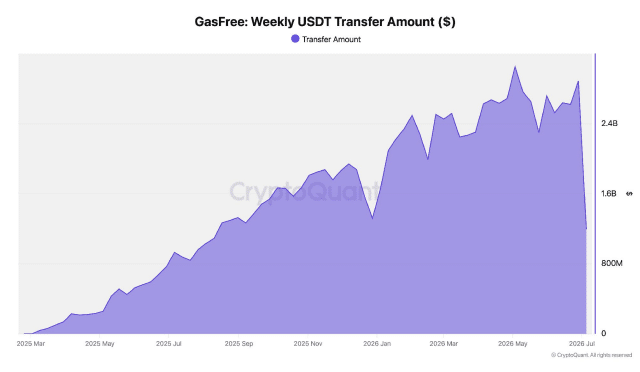
According to CryptoQuant report‘Gas-free’ USDT transfers hit a record high of $3 billion in 2026, from a low of $1.5 billion in January. In fact, gas-free transfer volume increased from zero at the beginning of 2025 to a record high in mid-2025, underlining its strong adoption.
The problem with traditional stablecoin payments
Traditionally, for someone to transfer funds between blockchains, you would need to hold the chain’s gas token to pay for bandwidth and energy usage. For Solana this would be SOL and for Tron this would be TRX.
In other words, without a gas token, you cannot benefit from the chain regardless of your USDT, USDC, or any stablecoin balance on the chain.
This has been a major friction point for payments to take advantage of the speed and prominent cost efficiency of stablecoin transfers. In fact, this has caused players like Stripe’s Tempo, Circle’s Arc, and the upcoming Google chain to remove their gas tokens.
Will GasFree take Tron beyond P2P stablecoin transfers?
To counter the competition, Tron announced its GasFree project, which will cut its network fee by deducting a small fee from each transfer. This is similar to traditional payments where the operator receives a portion of the transferred amount.
The model appears to be widely accepted and adopted. It was noteworthy that GasFree’s unique users reached a record of 30 thousand and the number of transactions reached a peak of 196 thousand. CryptoQuant added,
GasFree transactions and active users reached record levels, confirming a structural uptrend.
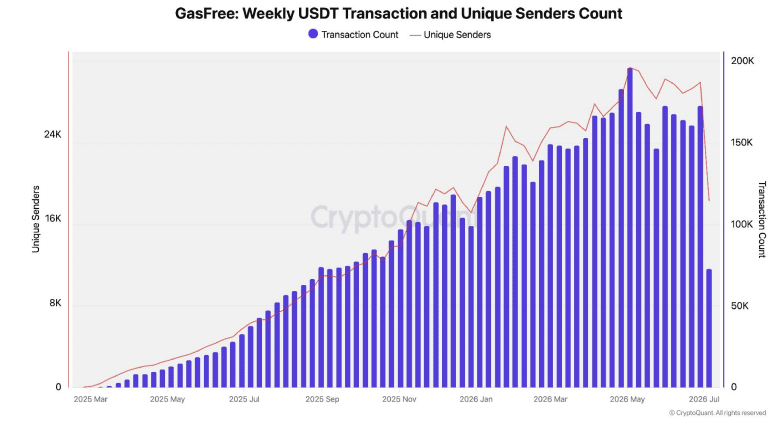
Based on increasing gasless USDT volume and adoption, CryptoQuant concluded that Tron is moving to the application layer, just like Stripe’s Tempo.
GasFree volume is currently well above the peak in 2025; This suggests that fee payment is not an exclusive facility, but a key facilitator of application activity on Tron, allowing projects to engage USDT-only users at scale.
In fact, some payment integrators such as Rhino.fi are already leveraging Tron for spendable USDT balances, further underlining this shift.
Additionally, gas-free transfers are reportedly stable and cheap, with an average fee of around $1.5 for a $16k transfer. This was a positive update on another friction point with traditional gas-based transfers; Fees will increase during the period when blockchain demand is highest.
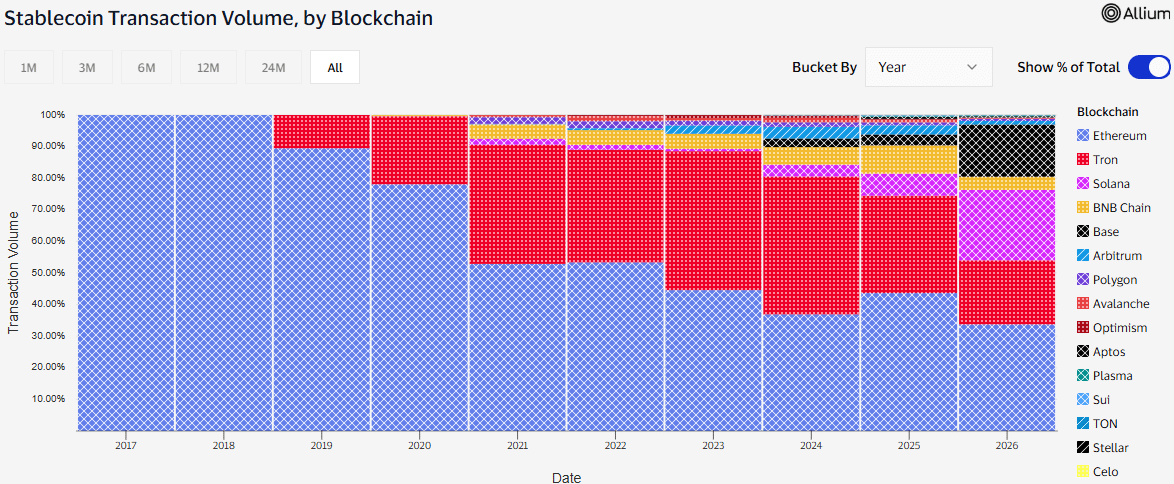
Time will tell whether other players such as Solana and Polygon will use the same method against rival players such as Stripe coming for market share. However, Tron’s stablecoin volume dominance has fallen from 43% in 2024 to 20% by mid-2026.
Final Summary
- Tron’s gas-free USDT transfers have increased from $1.5 billion to $3 billion in 2026 alone.
- This move comes as Tron’s market share in stablecoin volume has fallen from 43% to 20% since 2024.