
Every year I make investment plans behind the scenes to set some goal posts.
It is a useful process to evaluate where you are, where you have been, and where you are going.
I take our current net worth and savings rate. I then make some assumptions about future savings rates, income, and return expectations. These return expectations exist within a certain range because it is impossible to predict the future.
I then model all these numbers up to 5, 10, 15 and 20 years. I have been doing this exercise since I was 25 years old. The goal here is not certainty of my financial future. I try to create some road signs along the financial journey to see where things stand for planning purposes.
Because financial markets (and life, for that matter) are non-linear, assumptions will almost always be wrong. They are lumpy.
When expectations become reality, I can see whether we are doing better or worse than the results I predicted.
For example, actual output in the first 5-7 years of planning fell far short of my assumptions. From where? In the Great Financial Crisis, the stock market fell almost 60%. The feedback was terrible.
From 2005, when I first started investing in my retirement accounts, to 2010, stocks didn’t actually go anywhere:
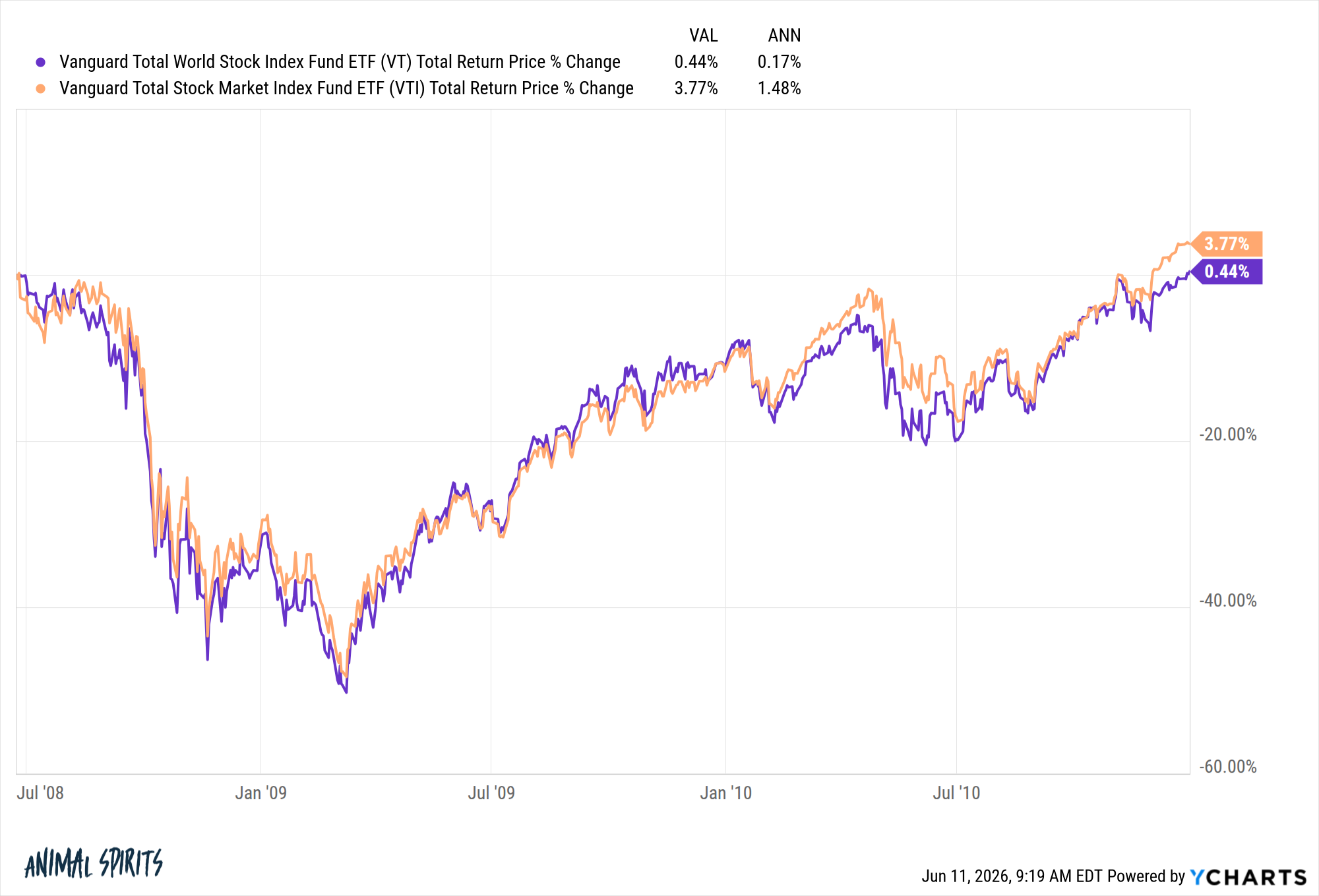
It was a brutal bear market.
I was still dutifully contributing to retirement, but I saw little progress in terms of investment returns and market value.
This type of environment can make you feel stupid as an investor. The good news is that I can periodically buy at lower prices in a highly volatile market.
Returns have been much better since then.
The S&P 500 is up more than 15% annually since 2009. A global stock portfolio returned around 12% annually. If I want to get really specific, the US stock market is up 16.9% per year since the Great Financial Crisis lows in early 2009.
No one creates a financial plan with return assumptions that high.
I definitely didn’t.
No sane person could have predicted that the bull market would last this long.
Due to the prolonged bull market, my portfolio is now much larger than my initial assumptions. In fact, the current reality did not even exist within my range of results.
But here’s the thing; I’m no smarter because the markets are up. Of course, I had to keep investing, but it wasn’t my raw intelligence that took my portfolio to levels I hadn’t planned for 5, 10 and 15 years ago.
Just as bear markets don’t make you stupid, bull markets don’t mean you’re a genius. I wasn’t a stupid investor during the Great Financial Crisis. I did what I had to do.
I bought it and kept it and everything went well.
Bull markets do not make you a smarter investor. Bear markets don’t make you a dumber investor.
The problem is that your emotions can often take over the steering wheel when markets are rising or falling.
Bear markets can make you question your plan.
Bull markets can lead to overconfidence.
I don’t know when the current bull market will end or why.
Maybe it will take another 5 years. If so, it doesn’t make you a smarter investor.
It may end tomorrow. If so, that doesn’t make you a dumber investor.
One of the ways I remind myself of how stupid I can be is to write things down.
Here’s what I’ll do and why I’ll do it. Here’s what I think might happen.
This is a great way to keep yourself grounded and avoid becoming outcome driven.
Process beyond results.
Further Reading:
Tops and Bottoms
This content containing security-related opinions and/or information is for informational purposes only and should in no way be relied upon as professional advice or endorsement of any practice, product or service. No guarantee or warranty can be given that the views expressed herein will apply to any particular case or circumstance and should not be relied upon in any way. You should consult your own advisors on legal, business, tax and other related matters regarding any investment.
The comments contained in this “post” (including any associated blogs, podcasts, videos, and social media) reflect the personal opinions, perspectives, and analyzes of Ritholtz Wealth Management employees making such comments and should not be considered the opinions of Ritholtz Wealth Management LLC. or its respective affiliates or a description of advisory services provided by Ritholtz Wealth Management or performance returns of any Ritholtz Wealth Management Investments client.
References to any security or digital asset or performance data are for illustrative purposes only and do not constitute investment advice or an offer to provide investment advisory services. The tables and graphs contained therein are for informational purposes only and should not be taken into account when making any investment decisions. Past performance is not indicative of future results. The content speaks only from the date specified. Any forecasts, forecasts, projections, targets, expectations and/or opinions expressed in these materials are subject to change without notice and may differ from or contradict views expressed by others.
The Compound Media, Inc., an affiliate of Ritholtz Wealth Management, receives compensation from various organizations for advertising on affiliate podcasts, blogs and emails. The inclusion of such advertisements does not constitute or imply endorsement, sponsorship or recommendation thereof, or any affiliation therewith, by the Content Creator or Ritholtz Wealth Management or any of their employees. Investments in securities involve the risk of loss. For additional advertising disclaimers, see here: https://www.ritholtzwealth.com/advertising-disclaimers
Please see the descriptions Here.