

A reader asks:
I’d like to hear your opinion on an article recently published in the Wall Street Journal: “You’re Probably Overinvested in Bonds.” My request focuses on the following paragraph:
“Most people should hold bonds. If you’re retired and living off your investment income, or if you’re going to have to sell a significant portion of your investments to cover your living expenses in a bad year, you should hold more of high-quality bonds. But that’s probably not true for two large groups: six million to seven million Americans with $1 million or more in investable assets, and other households with more than $100,000 in investable assets whose noninvestment income covers their cost of living.”
My wife and I are retired and in our early seventies. We comply with this statement. We have traditionally maintained an 80/20 equity/cash split and do not hold bonds. What do you think of Mr. Posen’s conclusions?
I get a lot of questions from retirees about how to manage fixed income distribution in retirement.
Some people want to hold cash instead of bonds. Some people want to know if it makes sense to keep all of your money in stocks.
Mr. Posen’s Wall Street Journal article has a similar tone.
The idea here is that a balanced 60/40 portfolio gives up too much on the upside. The 90/10 portfolio, on the other hand, is based on the idea that the stock market generally beats bonds over the long term.
Of course, as Mr. Posen touched on, you can’t get this positive effect without some drawbacks:
Stock declines are relatively rare and are often followed by increases, a pattern that has repeated over the past 60 years.
On average this is true.
By my count, there have been 39 double-digit stock market corrections in the S&P 500 since 1950. On average, this means a correction every two years.
Here are the numbers:
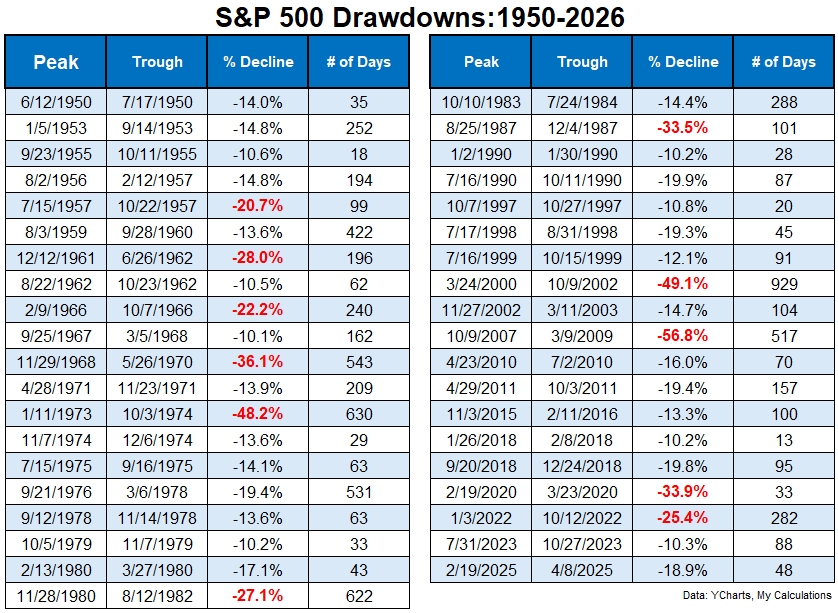
In these cases, the average decline of the S&P 500 was -20%. The average peak-to-trough decline took 193 days.
So this doesn’t feel like the end of the world.
But this is just a drop from top to bottom. Even if stocks hit bottom at this point and start rising, you’re still underwater.
The average number of days it took to reach breakeven during these corrections was 306 days. When we put it all together, this means a decline lasting approximately 500 days while new peaks are expected again.1
And that’s just average.
But what if you are exposed to a long bear market at an inopportune time?
These are all the bear markets since 1950:
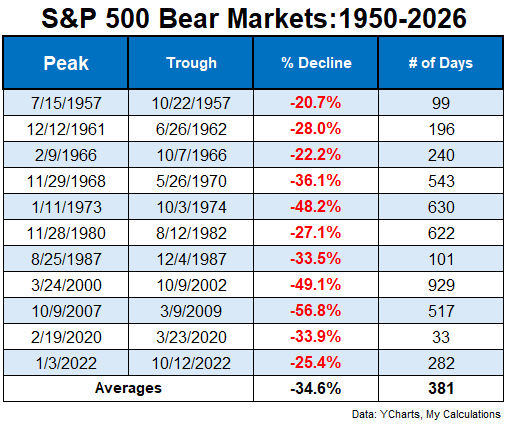
The average drop is much steeper and takes much longer to get to the bottom. It may also take much longer to reach new heights again.
After the bear market of 1973-74, it took almost 6 years to reach breakeven. It took four and a half years for the dot-com crash to hit bottom. The peak of the Great Financial Crisis was in the fall of 2007. New highs were not broken again until 2013.
Of course, the Covid crash took less than 150 days to recover from. Maybe the speed of the markets will shorten these downturns in the future? It’s definitely possible. Most of the time, recovery is a matter of months, not years.
In most cases, you’ll probably be fine with a 90/10 portfolio. And you’ll end up making a lot more money!
But such a high allocation to stocks in retirement is a risk unless you have some kind of backup plan.
For investors who currently invest money regularly in the market, long-term declines are not a risk but an opportunity. You can buy shares at lower prices.
You have a much smaller margin of safety in retirement.
There is no longer any income left from the work done to purchase the stock while it is on sale.
You don’t have time to wait out a painful bear market.
And if you don’t have a large enough fixed income position, you don’t have the powder to sit through the pain and buy stocks.
If you are going through a process contrarian bear market It can seriously affect your plan. If you spent your 10% in money markets, you now need to replenish that allocation, which may mean selling when stocks fall.
I agree with the author that retirees should probably take more equity risk than the textbooks say. People are living longer. You may have 20 to 30 years in retirement to keep up with inflation. You still need to take some risks.
If you’re going to make an extremely large allocation to stocks in retirement, I think you need to keep a really good handle on your spending. It can be dangerous if you’re taking on too much risk at the worst possible time when you don’t have any more money to work with in the market or you’re not expecting a long-term bear market to come.
You can leave money on the table by taking less risk in retirement.
But you only get one chance.
I discussed this question in a brand new episode of Compound Ask:
Bill Sweet helped us answer questions about timing your stock vacation property sale, inflation-hedge housing for teens, down payment size, and what financial gift to give for a Sweet 16 birthday.
Further Reading:
4-Year Rule for Retirement Expenditures
1It’s worth noting that I’m only using price data here. So on a total return basis, including dividends, this will shorten the period a little bit. But not a ton.



