

South Korean automaker Hyundai is doubling down on the use of stablecoins for internal transfers between its subsidiaries.
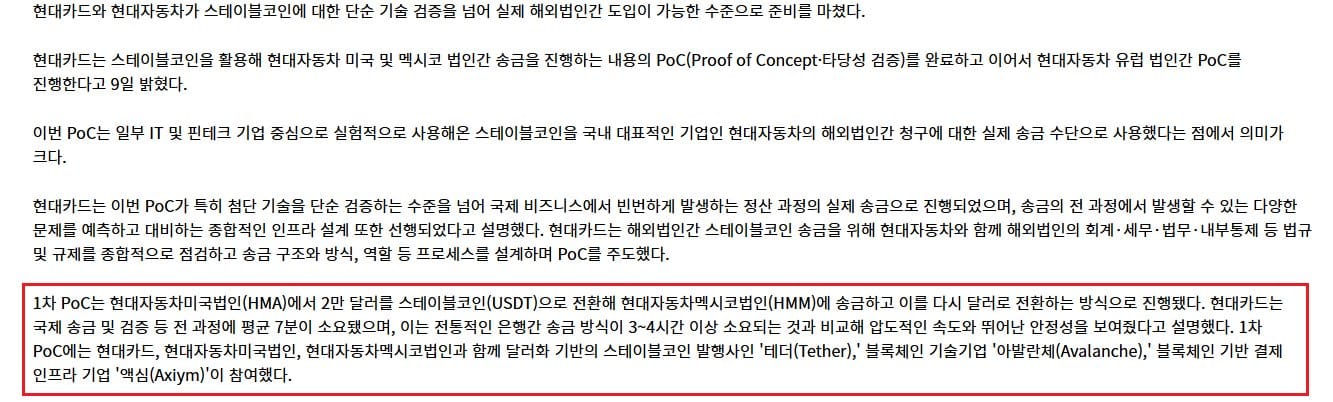
The automaker found transfers between subsidiaries in the U.S. and Mexico were faster during the testing phase. The firm said it takes about 7 minutes for Tether’s USDT to be transferred between its two offices, instead of the typical 4 hours or more seen with traditional interbank transfer methods.
Commenting on the testing, Hyundai praised stablecoin transfers as offering “overwhelming speed and superior stability” over traditional methods. The pilot project involved Hyundai Card, a credit card company owned by Hyundai Motors Group, Avalanche, Tether and payment integrator Axiym.
Tether CEO Paolo Ardoino described this move as an impressive “real-world adoption of USDT.” Tether US CEO Bo Hines evaluated the Hyundai move as “what the future of finance will look like.”
At the end of July, the automaker will conduct a similar test with Circle’s USDC and Visa for EU transfers.
For hyundaiThis was the basis for using and scaling stablecoins for remittances between overseas subsidiaries. But the credit card division plans to go beyond internal transfers. The company stated:
Going forward, we will explore and continually expand various businesses using stablecoins, including international remittance and payment infrastructure.
This indicates increasing adoption of institutional stablecoin.
Stablecoin adoption wars: USDT vs USDC
Stablecoins have evolved from a crypto experiment to a tool to address real global pain points: accessibility to the US dollar and cheaper, faster cross-border transfers.
Euro-based stablecoins have also seen significant growth, but still have a smaller market share compared to US Dollar-based alternatives.
However, the USD based segment is no longer increasingly competitive. The recent activation of the MiCA regime has seen USDC gain significant ground against Tether’s USDT.
In fact, USDC currently accounts for 63% of annual stablecoin transaction volume (about $6 trillion out of $9 trillion total). This was more than double Tether’s $3.3 trillion USDT volume (36%).
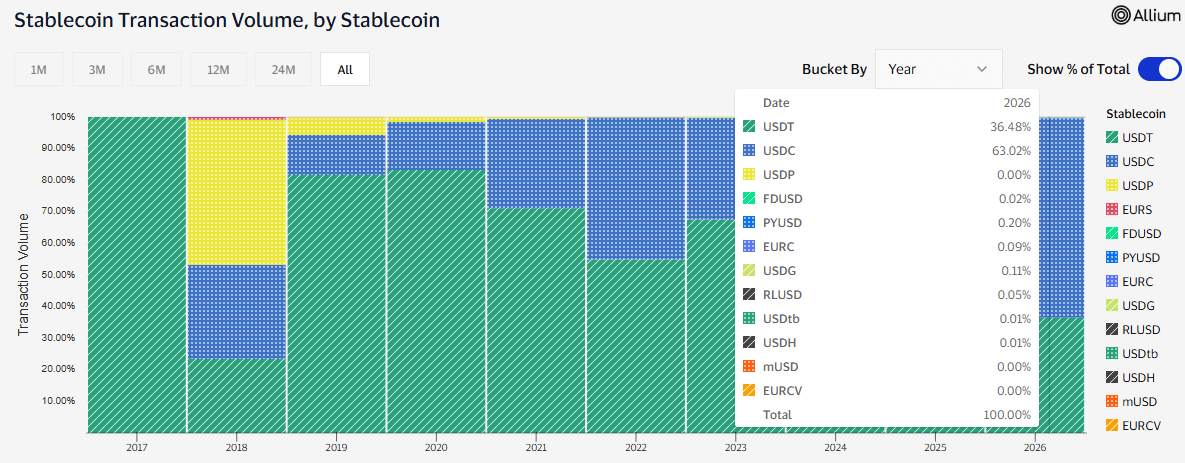
It is worth noting that this is the first time USDC has led in annual stablecoin transfer volume. It remains to be seen whether MiCA will allow USDC to maintain its dominance through the end of the year.
Final Summary
- Hyundai plans to scale internal stablecoin transfers using USDC and USDT
- USDC dominated 2026 stablecoin transfer volume with 63%, underscoring significant usage