

The market may be on the verge of its biggest divergence this cycle.
Pantera Capital, in partnership with S&P Dow Jones Indices, launched the first S&P Digital Asset Index, featuring a basket of 18 cryptocurrencies.
Naturally, this announcement caused a frenzy in the market. It spread like wildfire on social media and the timing couldn’t have been better. Bitcoin surged above $66,000, putting the market back in risk mode.
In this context, Pantera’s announcement added another layer to the bullish narrative.
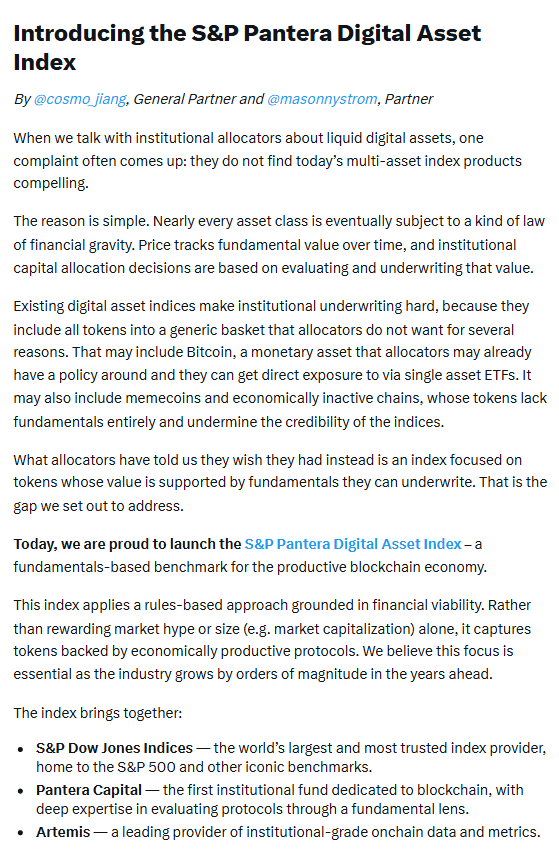
But the real debate wasn’t about what constitutes the S&P Digital Asset Index. It was about what wasn’t done.
For context, the index will feature 18 cryptocurrencies, but only the top five have been confirmed so far: Ethereum, BNB, Solana, Hyperliquid, and Tron. This is where the market frenzy began.
Despite being two of the biggest names in the crypto world, Bitcoin and XRP were left out. This immediately caught the market’s attention and sparked a broader debate about what the index was actually trying to capture.
According to AMBCrypto, this could exactly be one of the biggest differences in crypto’s next cycle. Until now, digital assets have largely traded as a high-beta risk trade, with Bitcoin leading this narrative.
But the exclusion of Bitcoin and XRP shows that the market is underestimating a much larger shift. If this is the direction enterprise products are heading, the next cycle could look very different.
S&P Digital Asset Index puts fundamentals first
After years of scaling and network upgrades, it looks like these efforts are finally paying off.
Notably, all assets approved in the S&P Digital Asset Index share one key characteristic: They are fundamentally powerful networks.
Over the years, these Tier 1 ecosystems have scaled, upgraded, and hard forked to improve efficiency, utility, and on-chain activity, moving beyond the “speculative asset” narrative.
This change is already visible in the data. One analyst noted that tokens included in the index at X have generated $3 billion in annual revenue in the last six months, despite the bear market.
In other words, the index appears to reward networks that create real economic activity, not just the largest market caps.

Considering most of the market is focused on BTC and XRP, this may be the biggest takeaway that gets overlooked.
Interestingly, Jon Ma, who worked with Pantera Capital and S&P Dow Jones Indices to create the S&P Digital Asset Index, in the name “It is the primary index for crypto.”
His thesis is simple: The next $10 trillion in cryptocurrencies is more likely to flow into networks with strong fundamentals, sustainable income, and real-world utility, rather than assets driven solely by market cap.
In this context, the launch of the S&P Digital Asset Index could be a significant turning point for the broader crypto market.
As institutional capital gains exposure through these benchmarks, the gap between price-driven momentum and fundamental strength could become one of the biggest themes shaping future crypto cycles.
Final Summary
- The S&P Digital Asset Index favors strong crypto projects: It focuses on networks with real growth, usage and value.
- Cryptocurrency’s next cycle could change as institutions begin selecting assets based on fundamentals and not just market trends.